
The New Frontline of Defence: AI Innovation for Drone Autonomy
_1256697_just%20image_zoom.png/v1/fill/w_320,h_320/file.jpg)
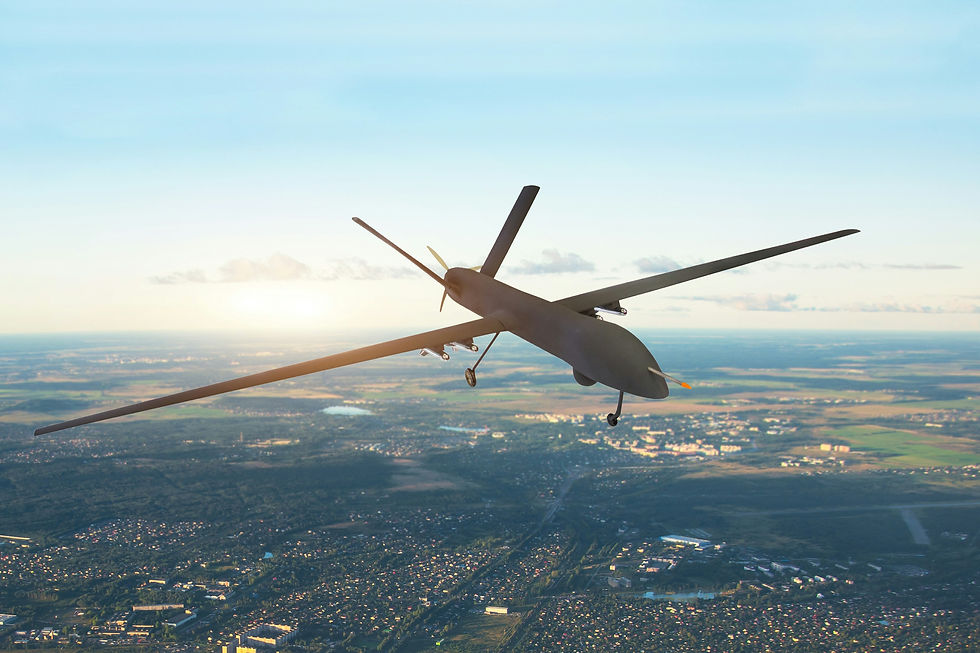
The defence and procurement landscape in Canada is rapidly shifting, with implications for the drone tech industry. In 2026, the government projects defence commitments of nearly $63 billion, with plans to increase them over the next decade. Concurrently, global defence spending is set to reach $2.8T, largely driven by recent conflicts like the war in Ukraine. Meanwhile, drones are revolutionizing the defence and security industries, but technology gaps remain, including challenges in drone autonomy and endurance. AI drone software can augment existing hardware, extending mission life, and unlock smarter UAV autonomy without forcing costly redesigns. AI‑driven planning can improve operational realities for ISTAR, surveillance, and logistics UAVs.
Drones at the Forefront of Defence & Security Innovation
Drone technology has become a driving force of defence innovation and investment — an evolution propelled by the Russia-Ukraine war and NATO’s push for greater defence spending.
But this increasing reliance on drones has exposed real‑world constraints: from inconsistent autonomy, limited endurance, challenging weather, and difficult terrain to integrating new technology into existing command systems.
For Canadian defence companies and subcontractors, those challenges present both risk and opportunity. Although hardware pipelines are rapidly expanding, in-field needs and dynamics shift quickly, requiring the agility that the software layer can provide.
A Generational Pivot: Canada’s Defence Spending Surge
Following the Canadian government’s recent landmark announcement, the country’s defence budget is now slated to hit the 2% of GDP NATO benchmark, potentially climbing to 5% of GDP under Canada’s Defence Industrial Strategy (DIS).
Canadian defence funding overview:
$62.7 billion in 2026 (approximately 2% of GDP, with a path to 5% by 2035)
$81.8 billion new investments over the next decade
$180 billion in procurement over the decade
For subcontractors and defence tech companies, this investment is expected to provide longer‑term visibility into procurement cycles, improving risk management accuracy and returns on investment.
Global Trends: World Events Fuel the Drone Wave
The post-pandemic world has seen seismic shifts across the geopolitical landscape, including the strengthening of multi-regional defence postures.
NATO allies, for instance, have since scaled procurement and R&D in response to the Ukraine war, with Europe accounting for ~21% of total global defence spending as countries re‑arm and modernize. Ongoing conflict across the Middle East also places a continued focus on defence positions. In Asia, spending continues to increase as well, with China’s defence spending reaching $247B in 2025, and India’s increasing by 15%.
On the drone front, advanced UAV technology is being integrated into both conventional and hybrid warfare. Industry analysts project that 2.9 million UAV system units will be delivered by 2030, up from nearly 2 million units in 2024.
“With the growing applications of unmanned systems in logistics, agriculture, defense, and surveillance, there has been a sharp rise in demand for these systems. In military applications, there is an escalating need for unmanned systems driven by substantial investments in defense technologies.” — Markets and Markets, 2025
The resulting surge in drone usage has placed pressure on the entire supply chain, across piloting, airspace management, maintenance, and autonomy. To help scale expensive missions across increasingly dynamic environments, AI drone “brains” can now help rapidly augment expensive UAV hardware.
Drone Advancements: More Autonomy for Smarter Flight
Defence drone missions have evolved beyond largely remote surveillance to involve AI‑driven decision‑making, coordinated operations, and persistent ISTAR.
Meanwhile, mission requirements are mounting. Operators are under pressure to fly longer, in adverse weather conditions, and across complex terrain — all while integrating data into command systems to improve situational awareness.
Breakthroughs like autonomous soaring (harnessing wind currents rather than fighting them) reveal how software can extend drone endurance without heavier batteries or larger airframes. Simply put, being able to conserve power means more intelligence can be gathered.
Navigating the Limits of Drone Hardware
Despite the success of defence and security drones, frictions do remain, from integrating data and systems to counter-drone technology:
System Integration: Many UAVs are bolted into legacy C2 and ISR stacks, creating data silos and constrained workflows.
Supply Chain Risks: Tariffs and restrictions on components (like those on Chinese drones) raise costs and complicate dual‑use design.
Airspace Complexity: Urban and contested environments require heightened detection and tight command coordination.
Counter-Drone Innovation: Counter-drone tech and urban drone detection have seen rapid innovation, led by countries like Isreal, the USA, and even Canada.
The AI Software Fix: Solving for Drone Hardware Limitations
Many of these challenges are hardware-related, but AI-centric software solutions can help mitigate them by providing modularity, hardware‑agnostic autonomy, and faster adaptation to new threats and regulations.
Optimize drone routes using micro‑weather data
Extend endurance without adding new hardware
Adapt in real time to changing conditions
Reduce operator workload
Increase the number of sorties an airframe can sustain
Support ISTAR‑centric missions where persistence matters more than raw speed
This way, ROI quickly becomes compelling, and operators can achieve higher mission success rates — especially when coordinating and scaling up existing UAV fleets.
Looking Forward: A Decade of Investment Spurs Innovation
With Canada’s Defence Industrial Strategy signalling a watershed commitment to defence capacity, the drone sector is poised for further innovation while upgrading existing fleets.
This should allow advanced algorithms to be applied across UAV systems — extending fleet range, improving resilience, and supporting the success of critical missions.
FAQ
What is Canada’s 2026 defence budget target?
Canada is targeting 2% of GDP in 2025–26, roughly $62.7B, with a path to 5% of GDP by 2035 supported by $81.8B in new investments and $180B in procurement.
What are the global defence‑spending trends?
Global defence spending is projected to reach around $2.8T, with many NATO and Asia‑Pacific countries ramping up investments in both platforms and supporting technologies, including AI and autonomy.
How do drones change modern defence?
They enable drone autonomy, swarm‑like coordination, and persistent ISTAR, turning UAVs from sensors into networked decision‑making nodes.
What software fixes drone limits?
AI‑driven mission‑planning and autonomy software (like Shearwater’s Smart Flight™) optimize routes, exploit weather, and extend endurance, all without hardware changes.


Comments